



How Often Should You Clean Your Dog’s Teeth?
What vets recommend, what is realistic on a busy week, and how to build a routine that sticks.

The short answer
Daily is the goal. The Veterinary Oral Health Council calls brushing the gold standard, and PetMD advises at least two to three times a week, ideally every day. If daily is not realistic, a steady two or three times a week is far better than a perfect routine you drop after ten days.
Key takeaways
- Ideal: every day. Realistic minimum: two to three times a week.
- Any regular cleaning beats none. Consistency matters more than session length.
- Home care does not replace a professional dental check at your vet.
- Dental disease is common: PetMD reports 80–90% of dogs aged 3 and older have it.
- Start slowly, keep sessions short and end with praise.
In this guide
Why frequency matters more than technique
Plaque is a soft, sticky film that forms on teeth again and again. Cleaning it away once a month does little, because it keeps coming back between sessions. That is why vets talk about a rhythm rather than a one-off effort. If you want the detail on how soft plaque turns into hard tartar, see our guide on plaque vs tartar in dogs.
The numbers show why the topic matters. PetMD reports that 80–90% of dogs aged 3 and older have dental disease. Regular cleaning at home is one of the few things an owner can do about it every single week.
The ideal: every day
The Veterinary Oral Health Council (VOHC), a group of veterinary dentists that reviews plaque and tartar products, states that “the gold standard is brushing” and that daily oral hygiene keeps teeth and gums healthy. PetMD likewise says daily is ideal.
Daily works because it matches how often plaque returns. It also turns cleaning into a habit, like feeding or an evening walk, so your dog learns to expect it. Many dogs find a short, predictable daily session easier than an occasional long one.
The realistic minimum: two to three times a week
Life gets busy. PetMD’s guidance is to brush your dog’s teeth at home at least two to three times per week, with daily being ideal. Treat that as your floor, and aim up from there when you can.
| Frequency | What it means | Good fit for |
|---|---|---|
| Every dayIdeal | Matches how often plaque returns; easiest to turn into a habit | Owners who can tie it to a daily moment, like after the evening walk |
| 2–3 times a week | The minimum PetMD advises | Busy weeks, dogs still getting used to the routine |
| Once a week or less | Better than nothing, but plaque has days to return between sessions | A starting point while you build up |
The VOHC and others make one point clearly: any cleaning is better than none. If you are currently at zero, start with once a week and build up.
If your dog resists a toothbrush, the routine can still work with a different tool. Our guide to cleaning your dog’s teeth without a toothbrush walks through a wipe routine step by step.
Home care plus regular vet check-ups
Home cleaning works alongside your vet, not instead of them. PetMD suggests a professional dental cleaning about once a year, and the VOHC recommends periodic veterinary oral exams. It also notes that many middle-aged and older pets need professional scaling as well as ongoing plaque control at home.
How often your dog needs a professional visit depends on age, breed and current mouth health, so ask your vet what schedule fits your dog.
A simple routine you can actually keep
- Pick a fixed moment. Right after the evening walk or just before dinner works well, because it ties the habit to something that already happens.
- Start small. A few teeth on day one counts. Add a few more each day until you reach both sides.
- Keep sessions short. Under a minute is fine. Stop while your dog is still relaxed.
- End with praise. A calm word or a small reward teaches your dog that the routine ends well.
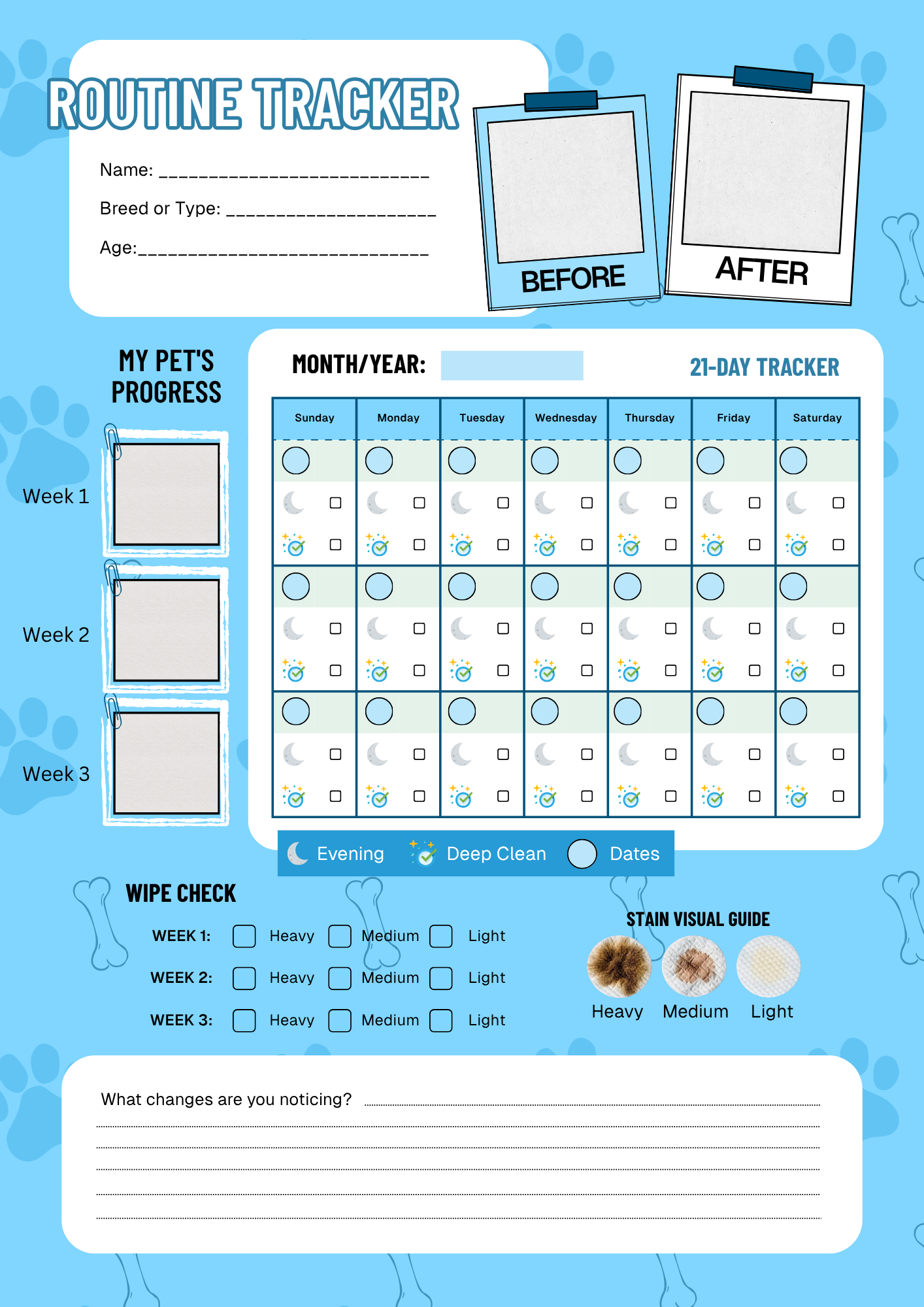
- Track it. A tick on the calendar for each session makes it obvious whether you are hitting two to three times a week.
If your dog tenses up, go back a step: let it sniff the tool, or touch only the lips for a few days before moving on.
How FreshWipes fit into the routine
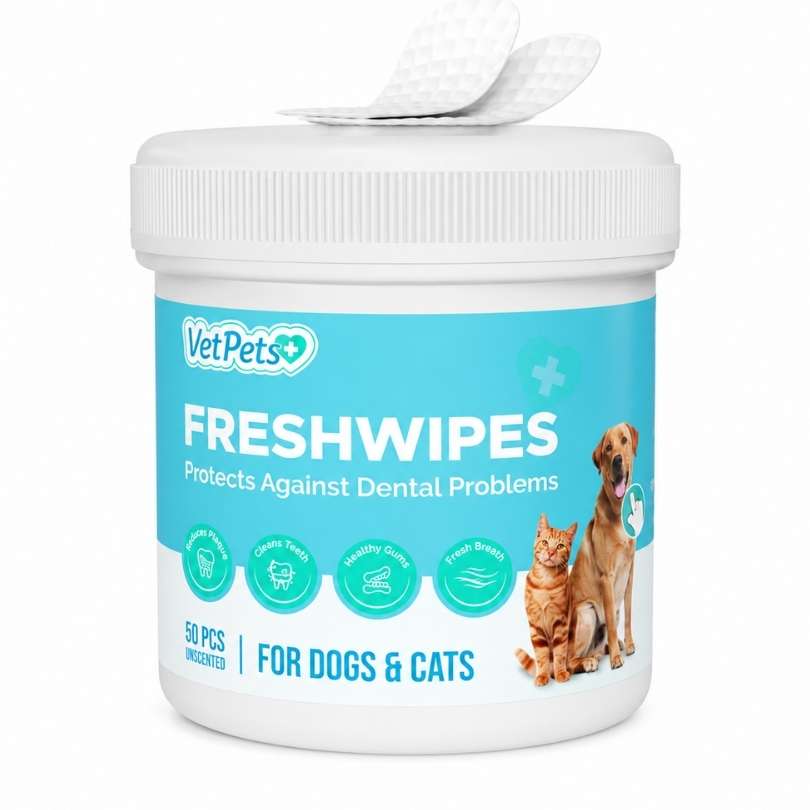
FreshWipes are a textured finger wipe made for the daily routine. They fit over one finger, so no toothbrush is needed, and are used to physically scrub plaque and food debris off the teeth and along the gumline. They are fragrance-free, alcohol-free, fluoride-free and pH-balanced, and are suitable for dogs and cats of all sizes. Each container holds 50 wipes.
FreshWipes are part of a daily-care routine. They are not a substitute for professional veterinary dental cleaning and they do not remove hardened tartar. Follow the directions on the pack for how often to use them.
Prefer to see everything in one place? Browse the finger wipes collection, or read more in our dog dental care hub.
When to see your vet
A cleaning routine keeps the surface clean. It cannot treat gum disease or fix a damaged tooth. Contact your vet if you notice:
- Difficulty eating or reduced appetite
- Bad breath that does not go away
- Red, swollen or bleeding gums
- Drooling
- Swelling of the jaw or face
- Discolored, loose or broken teeth
Many dogs hide pain. Talk to your vet before starting any new dental product, especially for puppies, seniors and dogs with existing mouth problems.
Frequently asked questions
How often should I brush my dog’s teeth?
Daily is ideal. PetMD advises at least two to three times per week as a minimum, and the Veterinary Oral Health Council calls brushing the gold standard.
Is brushing a few times a week enough?
It is a solid minimum and much better than nothing. Daily gives plaque less time to return, so aim for daily when you can. Your vet can tell you what suits your dog.
Does my dog still need a vet cleaning if I clean at home?
Yes. PetMD suggests a professional cleaning about once a year, and the VOHC recommends periodic veterinary oral exams. Home cleaning supports that care but does not replace it.
What if my dog will not let me use a toothbrush?
Try a different tool, such as a textured finger wipe, and build up slowly. Any regular cleaning is better than none.
Can FreshWipes remove tartar?
No. Tartar is hardened and needs a vet. FreshWipes are a textured finger wipe for the daily routine: they physically scrub plaque and food debris from the teeth and gumline.
When should I see a vet?
See your vet if you notice bad breath that does not go away, red or bleeding gums, drooling, trouble eating, a loose, broken or discolored tooth, or swelling on the face.
Sources
Reviewed by the VetPets Care Team. This guide is educational and does not replace advice from your veterinarian.



Make it a 30-second part of their day.
One wipe, a little praise, done. Every order is covered by our 100-Day Money-Back Guarantee.
Explore the daily routine