







Brown Teeth in Dogs: What It Means and What to Do
Why a dog’s teeth turn brown, how to tell tartar from a single damaged tooth, what you can do at home, and when to book a vet visit.

The short answer
Brown teeth in dogs are most often tartar: plaque that has hardened on the tooth. Tartar will not wipe off once it has formed, so your vet needs to remove it. A single tooth that turns reddish-brown, purple or gray is different and can mean an injury inside the tooth, so get that one checked soon.
Key takeaways
- VCA says plaque mineralizes into tartar, a rough material that attracts more plaque.
- Once tartar has formed, VCA says it needs professional scaling and polishing under general anesthesia.
- MSD Veterinary Manual lists a reddish-brown, purple or gray tooth as a sign of endodontic disease.
- Daily brushing is the best prevention, and MSD says wiping the teeth with gauze at least every 2–3 days can remove plaque in dogs that refuse a brush.
- Brown teeth with bad breath, red gums or a dog that drops food are a reason to call your vet.
In this guide
Why dog teeth turn brown
Three things can darken a dog’s teeth. Tartar is by far the most common. A damaged tooth that has changed color from the inside is less common but more urgent. Surface staining is the third, and a vet can tell it apart from the other two.
| What you see | Likely cause | What to do |
|---|---|---|
| Yellow-brown crust along the gumline, on several teeth | Tartar (hardened plaque) | Vet exam and professional cleaning; daily plaque control afterward |
| One tooth that is reddish-brown, purple or gray | Possible injury or disease inside the tooth (MSD) | Book a vet visit; X-rays confirm it |
| Red or swollen gums with brown teeth | Gingivitis alongside tartar | Vet exam; gingivitis is the reversible stage (VCA) |
Brown tartar: how plaque becomes a crust
VCA explains that the mouth is home to thousands of bacteria. As they multiply on the tooth surface they form plaque, an invisible layer organized as a biofilm. Your dog’s tongue and chewing remove some of it. The rest thickens and mineralizes into tartar, which VCA describes as a rough material that attracts even more plaque.
Plaque that touches the gums causes inflammation. VCA says gingivitis is always the first stage of periodontal disease and the only truly reversible one. MSD describes the gums changing from coral-pink to red or purple, with a swollen edge and bad breath. Our guide to plaque vs tartar in dogs shows the difference in detail.
VCA reports that over 80% of dogs older than three have active dental disease, and that small and short-nosed breeds are more prone because of their small jaws and crowded teeth. Brown tartar on a small dog’s back teeth is common, but it is still a signal to act.
One dark tooth: a different kind of brown
If only one tooth has changed color, tartar is less likely to be the whole story. MSD Veterinary Manual lists a tooth with a reddish-brown, purple or gray color among the signs of endodontic disease, which happens inside the tooth. Other signs include a painful tooth your dog does not want touched, a visible fracture, a red or black hole on the crown, facial swelling and a drop in appetite.
MSD says causes include injury, tooth fracture, enamel abnormality and tooth decay. Fractures can come from aggressive play or from chewing hard objects such as real bones, hooves, antlers, hard nylon toys or rocks. Most dogs mask their pain, and X-rays of the mouth are used to find the affected tooth. Treatment is a vet decision, either extraction or a root canal.
What to do at home
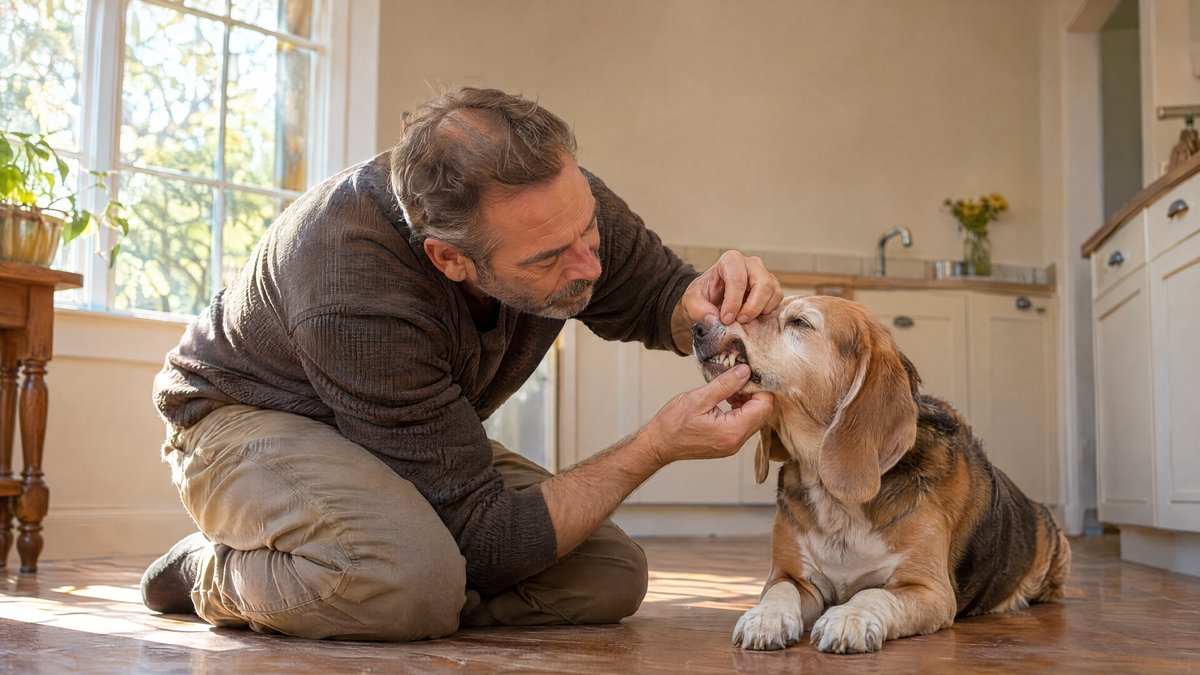
- Look properly. Lift the lip gently in good light and check the back teeth and the gumline. Note whether the brown is on many teeth or one.
- Check the gums. Coral-pink is normal. Red, purple or swollen gums, or bleeding, mean a vet visit (MSD).
- Book a vet check for any brown teeth you have not had looked at. Tartar needs professional removal, and your vet can rule out a damaged tooth.
- Remove fresh plaque daily. VCA says daily brushing with dog toothpaste is the best prevention. MSD says that if your dog will not allow a brush, wiping the outside of the teeth with gauze at least every 2–3 days can remove plaque. Never use human toothpaste (MSD).
- Choose chews carefully. Skip hard bones, antlers and hard nylon toys that can fracture teeth. VCA says the Veterinary Oral Health Council seal marks products shown to reduce plaque or tartar.
Need a routine that works with a dog that hates brushing? Read our routine for dogs that hate brushing or how often to clean your dog’s teeth. For the full picture, visit the dog dental care hub.
How FreshWipes fit into the routine
FreshWipes are textured finger wipes. You slip one over a finger and scrub plaque and food debris off the teeth and along the gumline, so no toothbrush is needed. They are fragrance-free, alcohol-free, pH-balanced and fluoride-free, for dogs and cats of all sizes. They help with the plaque step of the routine, before it can harden into tartar.
FreshWipes are part of a daily-care routine. They do not remove tartar that has already formed, and they are not a treatment for gum disease or a damaged tooth, nor a substitute for a vet dental exam or cleaning. Introduce them gradually and talk to your vet if your dog has known sensitivities.
When to see your vet
Home care cannot fix tartar or a damaged tooth. Contact your vet if you notice:
- One tooth that is reddish-brown, purple or gray
- Brown tartar thick along the gumline, or red, swollen or bleeding gums
- Bad breath that does not improve
- Pawing at the mouth, drooling, dropping food or chewing on one side
- A broken tooth, a hole in a tooth or swelling on the face
Your vet can examine the mouth, take X-rays where needed and suggest the right cleaning and home-care plan.
Frequently asked questions
Why are my dog’s teeth turning brown?
Most often it is tartar. VCA explains that plaque, a film of bacteria, thickens and mineralizes into tartar, a rough material that attracts more plaque. Tartar commonly looks yellow-brown. A single dark tooth is different: MSD Veterinary Manual lists a reddish-brown, purple or gray tooth as a sign of endodontic disease, so ask your vet to look.
Can I scrape brown tartar off my dog’s teeth at home?
No. VCA says that once tartar has formed, professional scaling and polishing under general anesthesia is needed, because it cannot easily be removed by diet or brushing. Scraping with a tool can hurt the gums and scratch the enamel. At home, focus on removing fresh plaque before it hardens.
Are brown teeth always a sign of dental disease?
Not always, but they are worth a vet check. Tartar is linked to gum inflammation, and VCA says gingivitis is always the first stage of periodontal disease. Your vet can tell whether the brown is surface tartar, a stain or a tooth problem.
Is one brown tooth different from brown tartar on many teeth?
Yes. Tartar usually builds on several teeth, mostly toward the back and along the gumline. One tooth that is reddish-brown, purple or gray, especially with pain, a fracture or facial swelling, can mean a problem inside the tooth. MSD says a vet can confirm it with X-rays.
How can I stop brown tartar coming back?
VCA calls daily brushing with dog toothpaste the best way to prevent tartar build-up. MSD adds that wiping the teeth with gauze at least every 2–3 days can remove plaque in dogs that do not allow brushing. Your vet can advise on chews, diets and the products VOHC has accepted.
Do small dogs get brown teeth more often?
VCA says small breeds and short-nosed breeds are more prone to periodontal disease because of their small jaws and crowded teeth. MSD notes that small-breed dogs usually have more problems with periodontitis than large breeds. That makes a regular routine and checkups even more useful for them.
Sources
Reviewed by the VetPets Care Team. This guide is educational and does not replace advice from your veterinarian.


Stop plaque before it turns brown.
A quick, gentle daily routine your dog will accept. Every order is covered by our 100-Day Money-Back Guarantee.
See FreshWipes